When answers show up, where did traffic go?
You’ve seen the pattern: search impressions hold steady (or even rise), but sessions from “organic” flatten and then slide. The shift isn’t always that demand disappeared; it’s that the demand gets satisfied earlier. When a search page, browser sidebar, or assistant can summarize options, compare specs, or extract a “best answer,” many users stop at the answer layer instead of opening ten tabs.
That creates a new kind of leakage. Your content can be “used” without a visit, and your costs don’t fall just because clicks do. If you rely on last-click attribution, it can look like channels stopped working when, in reality, the channel’s role moved up the funnel and became harder to observe.
Clicks were the currency—what replaces them now?
The familiar spreadsheet breaks when clicks stop being the default “proof.” A click used to be a clean exchange: attention for a measurable action, priced through CPC, optimized through conversion rate, and explained through last-touch paths. In an answer-first experience, the exchange can happen without the visit. The user learns, shortlists, and forms preference while your analytics see nothing but an impression—if you even get that.
What replaces clicks is a messier bundle of signals: qualified exposure inside answer surfaces, downstream demand that shows up later as branded search or direct traffic, and first-party audience relationships you can recognize without an intermediary. That pushes measurement toward incrementality tests, geo or time splits, and brand-lift style outcomes, because deterministic attribution will undercount “assist” value. The practical constraint is cost: these methods require clean experiments, patience, and statistical power, and many teams will need to trade speed of reporting for accuracy.
Attribution in an AI world gets messy fast
Consider a common path: someone asks an assistant for “the best project management tool for agencies,” sees your brand in the answer, and then later types your name directly, downloads the app, and upgrades after an in-product prompt. In most analytics stacks, that looks like “direct” or “brand search” did all the work. The assistant exposure disappears, and your non-brand efforts get undervalued even if they created the first impression.
It gets worse when the answer blends sources and paraphrases claims. You may get credit for demand you didn’t create (“they mentioned us, so we must have influenced it”), or lose credit when your differentiator shows up without your name attached. Even within paid media, model accuracy drops as cookies fade and journeys shift across devices and surfaces you don’t control.
The practical adjustment is to treat attribution as a set of hypotheses, not a scoreboard. Use holdouts, geo tests, and pre/post experiments to estimate lift, and track “mention share” and branded demand as leading indicators—while accepting that precision will cost time, tooling, and patience.
New ad inventory: inside answers, not around links

Picture the search result that used to be ten blue links with ad units on top and down the side. Now it’s a single, confident answer with a short list of “recommended” options. That’s a change in real estate, not just format: the monetizable surface moves into the answer itself. Instead of buying placement around destinations, platforms can sell placement inside the decision moment—sponsored citations, “recommended for you” callouts, product cards, or follow-up prompts that steer the next question.
For advertisers, this behaves less like classic click-based intent capture and more like paid inclusion at the point of synthesis. The upside is strong context: the assistant already knows the query and can narrow choices. The downside is control and verification. If you can’t see the full answer, can’t audit what claims were shown, or can’t reliably connect exposure to downstream behavior, pricing and brand safety get harder. Expect measurement to lean on viewable exposure, incremental lift, and first-party conversion signals rather than CTR.
How brands earn ‘mentions’ when nobody clicks
You can already see the new competition surface: not “who ranks,” but “who gets named.” When an assistant summarizes a category, brands that show up tend to have three advantages—clear positioning, repeated third-party confirmation, and machine-readable facts that don’t get lost in paraphrase. In practice that means tightening your narrative (one sentence a model can reuse without distortion), publishing stable specs and policies (pricing ranges, availability, guarantees), and earning corroboration in places assistants frequently pull from: credible reviews, comparison write-ups, forums, app marketplaces, and industry directories.
Mentions also come from being easy to recommend. If your onboarding, customer support, and cancellation flow create predictable outcomes, users describe you consistently, which improves “mention share” over time. The constraint is that this isn’t a quick bid-based fix. PR, partnerships, and product improvements are slower and harder to attribute, and you may need to accept softer leading indicators—brand search growth, repeat inclusion in answers, and higher conversion rates on the visits you do win.
Publishers and creators: monetization after the click
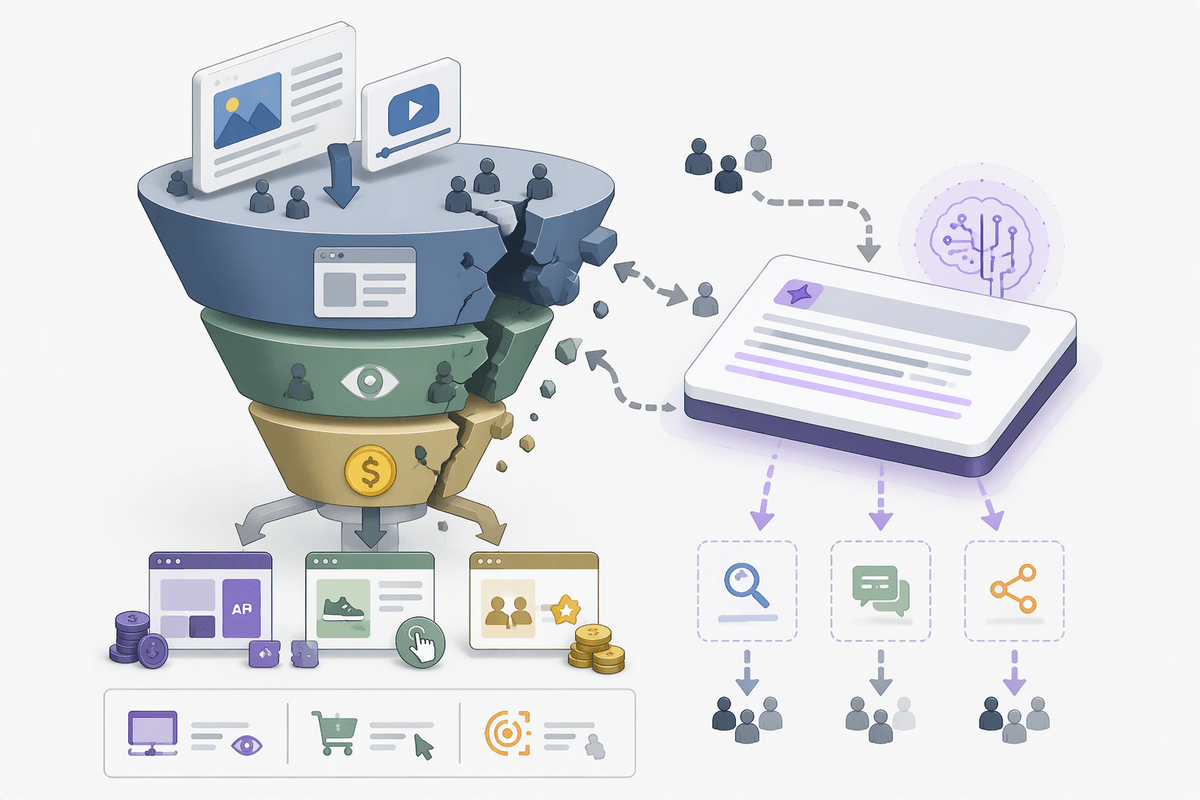
A recognizable reality for publishers: the article still gets “read,” but in a summary panel you don’t control. That breaks the old trade—free discovery in exchange for on-page ads, email signups, and pixel-based retargeting. The exposed models are the ones that require a pageview to pay: display CPMs, affiliate clicks, and many sponsorship packages priced on sessions. Even loyal audiences drift if the assistant answers the “good enough” version of your work and only sends a fraction of users through.
The survivable models shift value to what can’t be fully captured in an excerpt: proprietary tools, data, calculators, paywalled depth, member communities, and events. Bundling helps, too—sell sponsorships against first-party audiences (newsletters, podcasts, apps) where identity and measurement are stable, and price on outcomes like qualified leads or renewal lift. The practical constraint is investment: building products and subscriptions takes time, and many teams will need to accept lower short-term yield while they repackage what they already know into formats assistants can’t replace.
A practical plan: measure, diversify, run small tests
Start with measurement you can trust: separate brand vs non-brand demand, track “mention share” in priority prompts, and build a simple baseline of assisted exposure → branded search → first-party conversion. Then run small holdouts (geo, audience splits, time-boxed pauses) to estimate lift, because attribution models will over-credit whatever gets the last measurable touch. Diversify the surfaces you control: newsletter, app, community, and direct partnerships that don’t depend on a click from an answer layer.
Keep tests cheap and concrete: one sponsored in-answer placement, one content format designed for quoting, one publisher bundle priced on leads. Expect friction—data access, longer cycles, and fewer clean “wins”—and set decisions around directionally consistent lift, not perfect precision.