When “not enough evidence” is the real question
You ask an AI a straightforward question—what caused a dip in conversion, whether a quote is accurate, which policy applies—and it answers instantly. The real risk is that the question often isn’t “what’s the answer?” but “do we have enough evidence to answer at all?” In day-to-day work, missing context hides in plain sight: a date range, a definition, a source, or a key assumption you didn’t realize you were making.
When a model can’t reliably flag those gaps, it may supply a clean, decisive explanation anyway. That can save minutes while quietly creating hours of cleanup: chasing a false lead, publishing an uncheckable claim, or building a decision on invented details. The practical skill is learning to notice when “insufficient evidence” should have been the first output.
What counts as incomplete evidence, in practice
Missing evidence often becomes apparent only when an answer needs to support a real decision. A model may provide a detailed explanation without the evidence expected from a colleague, such as a source for a quotation, a specific dataset behind a metric, or the exact policy version relevant to a compliance question. Gaps also arise when inputs are vague, terms lack clear definitions, or assumptions remain unstated. “Last quarter” needs a defined date range, “active user” needs an agreed measurement rule, and comparisons need a clear market, customer segment, and baseline.
Some questions depend on information the model cannot access directly, including analytics results, decisions made in closed meetings, or changes in a private codebase. Public information also needs a date check when regulations, prices, or leadership positions may have changed. Filling these gaps takes time, but proceeding without verification risks errors that undermine the work’s credibility and lead to poor decisions.
Why models often sound sure even when wrong
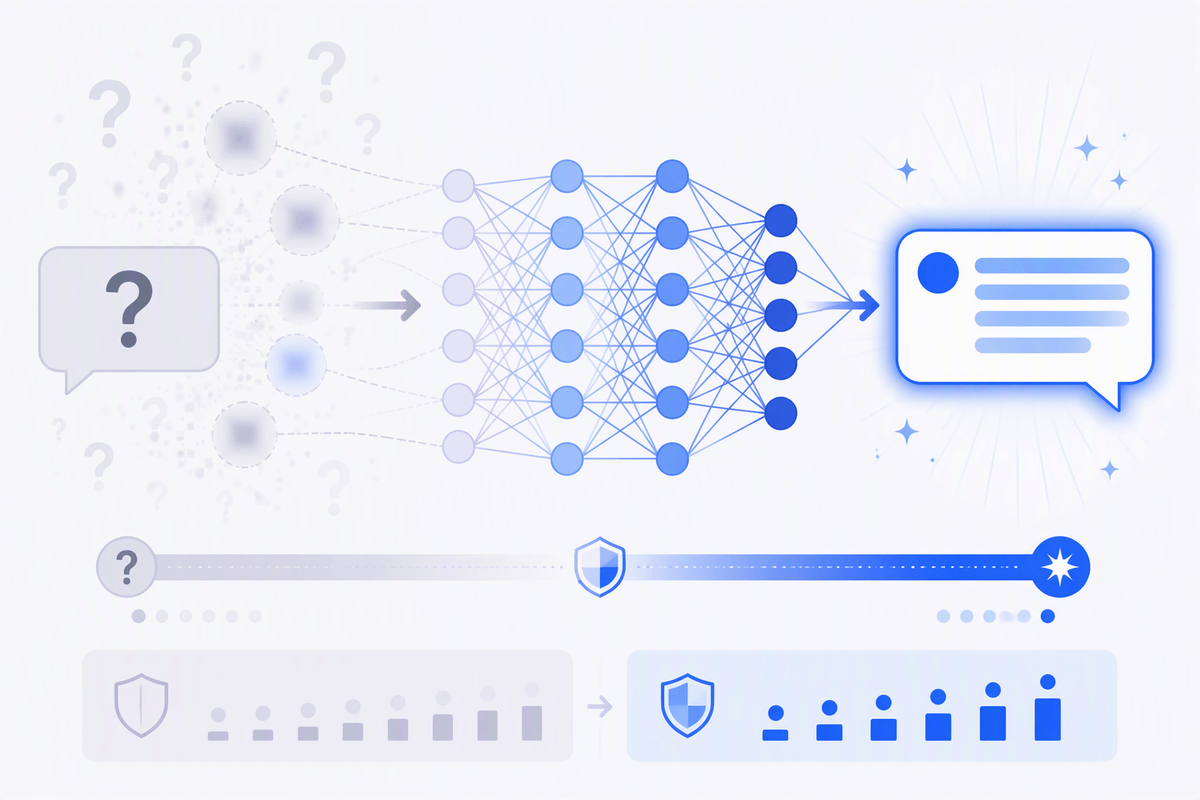
A common surprise is that the model’s “confidence” is mostly a writing style, not a measurement of evidence. Most chat models are trained to keep producing the most likely continuation of a prompt, and they’re rewarded for sounding helpful, coherent, and decisive. When the input is underspecified, the easiest way to stay coherent is to pick one plausible story and elaborate—especially if your question reads like it has a single right answer (“What caused the dip?”) rather than a diagnostic (“What would you need to know to tell?”).
They also don’t naturally track uncertainty the way a careful analyst does. Unless you force it, the model won’t pause to list missing variables, separate knowns from guesses, or say “I don’t have access to your data.” Adding those guardrails can feel slower and more awkward in conversation, but the speed you save up front is exactly what encourages confident filling-in when evidence is thin.
Signals that hint the model is guessing
You’ve probably seen the pattern: the answer feels smooth, but you can’t tell what it’s grounded in. One signal is specificity without anchors—precise percentages, dates, names, or “industry benchmarks” that arrive with no dataset, timeframe, or source you could verify. Another is causal certainty from thin inputs: a single metric drop gets explained as “seasonality,” “pricing friction,” or “tracking changes,” with no request for basics like channel mix, attribution changes, or experiment history.
Watch for overconfident formatting that substitutes for evidence: long step-by-step narratives, authoritative tone, or a neat list of “root causes” that doesn’t separate observation from hypothesis. Models also guess when they ignore your constraints (region, policy version, “as of” date) or fail to ask obvious clarifying questions a colleague would need before committing. The practical test is whether you can trace each claim to an explicit input, a cited source, or a stated assumption—if not, treat it as a draft theory, not an answer.
Ways to make an AI notice what it lacks
An AI explanation may sound complete even when the model has not checked whether the necessary information is available. To expose those gaps, ask it to separate “what the prompt establishes” from “what still needs to be known,” then label each claim as supported, assumed, or speculative. If an important detail is missing, such as the reporting period, customer segment, metric definition, source, or policy version, have it pause and ask a few focused questions before proceeding. This may add a step, but it helps prevent unsupported conclusions from being presented as facts.
Clear limits also work better than general requests to be careful. Instruct the model not to invent figures, quotations, or names, and to state plainly when it cannot verify a claim against the sources provided. For internal projects, make access assumptions explicit: unless the relevant information has been shared, the model should not claim to have inspected company dashboards, databases, or code. When the evidence remains inconclusive, ask for two plausible explanations and the specific observations that would help distinguish them. The additional exchange makes the reasoning easier to examine and gives the final answer a firmer evidentiary basis.
Testing whether it truly knows or just sounds right

A practical way to test “does it know?” is to ask for outputs that are hard to fake. Have it produce a short claim-and-support table: each claim, what it’s based on (your prompt, a quoted excerpt you provided, or a clearly labeled assumption), and what would falsify it. Then ask it to restate the answer under stricter rules: “same conclusion, but remove every sentence you can’t ground in an explicit input.” If the core collapses, the earlier certainty was mostly style.
Use consistency checks that mimic real review. Ask it to answer twice from different angles: first as a cautious analyst, then as a skeptical auditor trying to disprove the analyst. Or request boundary cases: “What would change your answer?” and “Under what conditions is the opposite true?” Finally, force retrieval discipline: “quote the exact line from the provided text that supports this.” These tests add steps—but they’re cheaper than verifying a polished hallucination after it’s already spread into a doc, deck, or decision.
Choosing the right workflow for incomplete evidence
You rarely need a single “trust” decision; you need a workflow that matches the downside. For low-stakes ideation, let the model brainstorm, but keep outputs labeled as hypotheses and strip any uncited facts. For medium-stakes analysis, use a two-pass pattern: first, gap list and clarifying questions; second, a constrained answer that separates observed inputs from assumptions and proposes checks. For high-stakes work (legal, medical, financial, publication), treat the model as a drafting assistant: require primary sources you can inspect, then verify outside the chat. The trade-off is speed, but it buys control.