Why blockchain analysis feels harder than it should
You pull a wallet address, paste it into a block explorer, and expect a clean story: who paid whom, for what, and whether it matters. Instead you get thousands of transactions, unfamiliar token contracts, and clusters of addresses that may or may not belong to the same entity. Even basic questions—“is this revenue,” “is this a customer,” “did funds come from an exchange”—turn into guesses unless you add labels, time windows, and context from outside the chain.
The friction isn’t just volume. It’s that blockchain data is precise about transfers but vague about intent. The same movement can be payroll, laundering, market making, or a bot rebalancing liquidity. Good analysis usually requires stitching together heuristics, vendor attribution, and manual checks. That takes time, costs money in tooling and data, and still leaves uncertainty you need to communicate clearly.
Start with the questions that actually matter
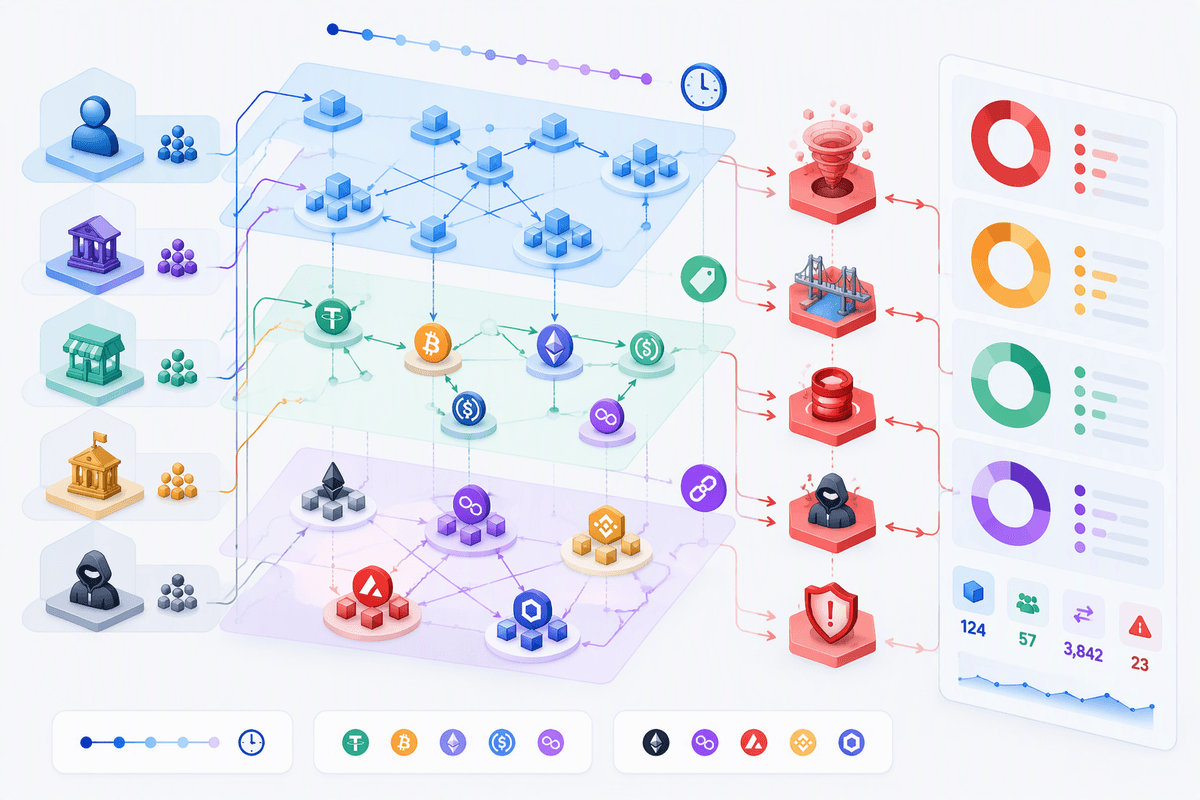
Someone asks “what happened with this wallet,” but that’s rarely the decision you need to support. A tighter starting point is a question with an action attached: “Did this inflow originate from an exchange or a known counterparty within the last 30 days?” “Are these transfers consistent with normal customer deposits, or do they look like consolidation?” “What portion of outflows touched mixers, bridges, or high-risk services before landing at our deposit address?” Those questions imply boundaries (time, asset, chain), a unit of analysis (entity, cluster, transaction path), and a measurable output (percent, count, top counterparties).
AI assistants help most when you give them that structure up front. They can draft a trace plan, propose labeling hypotheses, and generate a checklist of validations. They cannot replace missing ground truth: attribution data may be stale, heuristics can over-cluster, and some paths are expensive to resolve when fees or cross-chain hops force you to sample rather than exhaustively trace.
On-chain data, off-chain context, and the messy middle
A common snag is that the chain gives you perfect ledgers and imperfect identities. You can see that USDC moved from A to B through a router contract, but not whether it was a customer payment, a treasury rebalance, or a market maker cycling inventory. Even “simple” categories like exchange, merchant, and protocol are often shorthand for a bundle of addresses, deposit intermediaries, and smart contracts that change over time.
The messy middle is where you combine on-chain patterns with off-chain signals: support tickets, invoice IDs, marketing campaigns, KYC records, IP logs, or even a public announcement that a project rotated wallets. AI can help propose which context matters (“Does this spike align with a listing?”), normalize messy exports, and highlight anomalies (new counterparties, sudden bridge usage, unusually fast peel chains). You can’t blindly feed sensitive customer data into a generic model, and you still need rules for what counts as a confirmed label versus a working hypothesis.
Choosing an AI assistant: chat UI or embedded analyst agent
You can feel the difference between a chat-style assistant and an embedded “analyst agent” the first time you rerun the same question a week later. A chat UI is great for exploration: “Summarize top counterparties,” “Explain this contract interaction,” “Draft a narrative for these inflows.” It’s fast, low setup, and useful when the cost of being slightly wrong is limited to a hypothesis you’ll verify anyway.
An embedded agent sits closer to your data and workflow. It can execute saved queries, apply consistent labeling rules, track assumptions, and attach provenance (which dataset, which block range, which attribution source). That makes it better for recurring reporting, alert triage, and compliance reviews where you need repeatability. The trade-off is real overhead: permissions, data access reviews, prompt and tool configuration, and ongoing maintenance when schemas, chains, or attribution vendors change. If you can’t answer “who can see what, and where did this label come from,” start with chat and keep outputs explicitly tentative.
A workflow that keeps AI fast but accountable

The pressure point is familiar: you need an answer before the window closes, but you also need to defend that answer later. A workable pattern is to let AI do the first pass, then force it into “auditable mode.” Start by having it restate the question as testable claims (“inflows mostly originate from exchanges,” “no mixer exposure in the last 30 days”), and require a minimal evidence bundle for each claim: the exact address set or cluster definition used, chain and block/time range, assets included, and the top transactions or paths that drove the conclusion.
Then split work into two tracks: exploration and reporting. Exploration can be messy—hypotheses, partial traces, rough labels—but it should end with a short validation checklist you can execute in your primary tools (re-run a query, spot-check a sample of paths, confirm labels against your attribution source, and note uncertainty). Reporting should only accept “confirmed” artifacts: saved queries, pinned datasets, and labeled entities with a source and date. The deep tracing across bridges, routers, and high-activity contracts can be expensive, so design the workflow to sample deliberately and document what you did not resolve.
Failure modes: hallucinations, false labels, and shaky attribution
You’ll notice the first failure mode when the assistant sounds confident about details you never provided: “this is a Binance deposit address,” “these funds came from a mixer,” “this contract is a staking vault.” Those statements can be plausible and still be invented, especially when the model is filling gaps between partial traces, ambiguous token symbols, or missing block ranges. Treat any un-cited proper noun (exchange, protocol, person, “hacker group”) as untrusted until you can tie it to an attribution source, a deterministic heuristic you control, or a transaction path you can reproduce.
Over-clustering can merge unrelated users behind a router, paymaster, or shared custody service. Under-clustering can split one entity into dozens of deposit intermediaries and make normal activity look like structuring. The practical fix is to version your labels, date-stamp the source, and keep a “why” field (tag from vendor, heuristic match, internal confirmation). Attribution will drift as wallets rotate, so build reports that tolerate “unknown” instead of forcing certainty.
Where AI assistants deliver quick wins today
A familiar win is turning a messy address or transaction list into a usable starting point fast: normalize formats, dedupe, group by asset and counterparty, and draft a first-cut narrative you can refine. Assistants also do well at “explain this interaction” work—what a router, bridge, or staking contract likely did—when they’re forced to cite the exact calls and transfers they’re describing. For ops teams, the quickest value is templated outputs: an incident brief, a compliance note with assumptions, or a weekly top-movers report built from saved queries. Anything involving identity (who) still needs independent attribution and spot checks.